
The rapid development of the Johor-Singapore Special Economic Zone (JS-SEZ) and the commercial expansion of Medini represent one of the most dynamic economic initiatives in Southeast Asia. For Singaporean business owners and international investors, this cross-border integration unlocks an unparalleled landscape for scaling operational capacity and tapping into vibrant regional talent.
However, true operational resilience across the Causeway requires a clear understanding of the regulatory guardrails that define each market. While capital and logistics move seamlessly, employment law frameworks remain distinct.
At S. K. Low & Co., we assist foreign companies in ensuring their entry into Johor is built on a stable legal foundation. The most critical step in this journey is transitioning away from standard “at-will” practices and embracing Malaysia’s structured approach to workforce management.
Embracing the Stability of the “Just Cause” Framework
In Singapore, employment relations may place high value on absolute contractual flexibility, often utilizing “termination simpliciter” where a relationship can be concluded simply by serving notice and often without assigning any reason.
Malaysia’s framework is built around a different philosophy: long-term workforce stability.
Under Section 20(1) of the Malaysian Industrial Relations Act 1967, the law protects the sustainability of the labor market by requiring that any dismissal be backed by a “just cause or excuse”. This statutory principle acts as an objective framework that applies to all personnel, including even those on probation.
For an expanding business, understanding this rule is an advantage. It ensures that separations are never arbitrary, protecting the company from sudden operational disruption and the brand reputation risks associated with unresolved Industrial Court disputes.
The 3 Structural Pillars of Labor Management
Rather than restricting an employer’s ability to manage their workforce, Malaysian jurisprudence provides clear, structured pathways to handle any organizational transition:
1. The Poor Performance Track: Underperformers are required to be notified of any shortcoming on their part and be given ample opportunities to improve. In addition, they must be managed through documented Key Performance Indicators (KPIs) and a structured Performance Improvement Plan (PIP). This protects the company by ensuring employees are given a clear, fair track to reach operational excellence.
2. The Misconduct Track: Misconduct is addressed through a structured, transparent process involving formal Show Cause Letters and an internal Domestic Inquiry (DI). This underlying process is intended to ensure due process and allows the employee to be given the right to be heard. This process safeguards management decisions against claims of procedural bias.
3. The Redundancy Track: Business pivots or economic redundancies are handled via clear and objective guidelines—such as skills, competence, qualifications, “Last-In, First-Out” (LIFO) selection rule — ensuring corporate transitions are fair, organized, and legally sound.
Securing Your Corporate Capital
When foreign companies proactively localize their HR frameworks, they prevent the friction that leads to costly statutory claims—which can legally reach up to 24 months of backwages + compensation in lieu of reinstatement which is calculated based on 1 month’s salary for each completed year of service (where reinstatement is not practicable) under the Industrial Court’s remedies. Imagine having employed high-wage employees to receive the tax benefits under the JS-SEZ framework but did not observe the local statutory framework when terminating them. How painful is that when their basic salary is relatively high?
Establishing compliant onboarding contracts, understanding local salary thresholds (such as the RM4,000 baseline for statutory overtime protections), and adhering to proper documentation practices are not bureaucratic hurdles; they are strategic assets that secure your corporate capital.
By aligning your international corporate vision with local statutory standards, your firm can build a highly productive, loyal, and legally secure workforce that drives long-term profitability within the JS-SEZ.
Are you ready to optimize your cross-border HR framework for long-term growth?
🎁 Download Your Complimentary Executive Guide
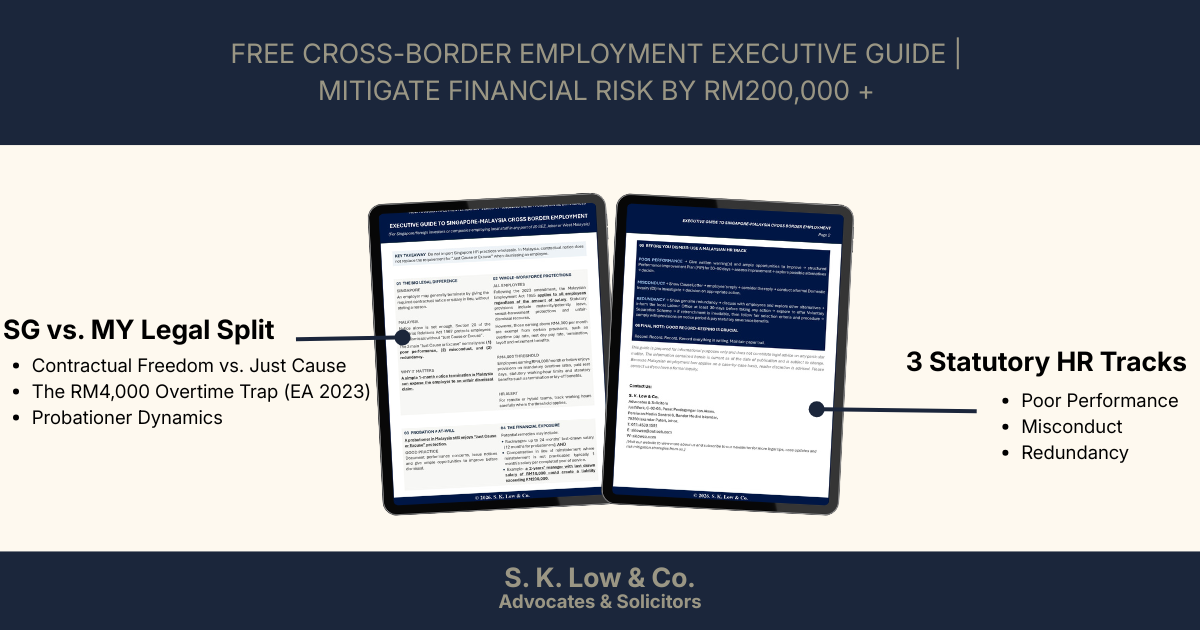
To help cross-border investors and international corporate boards systematically identify their corporate vulnerabilities, we have consolidated these complex statutory lines into a single, high-resolution 2-page tool:
📘 Executive Guide to Singapore-Malaysia Cross Border Employment
This executive document outlines:
(a) The Big Legal Differences: Contractual notice freedoms vs. strict statutory “Just Cause” protections.
(b) Whole-Workforce Protections: Understanding the 2023 Employment Act amendments and how the RM4,000 salary threshold impacts overtime, working hours, and termination benefits.
(c) Probationer Dynamics: Highlights the statutory protections for employees still under probation.
(d) The Statutory HR Tracks: Exact step-by-step workflows for handling Poor Performance, Misconduct, and Redundancy.
Please complete the brief corporate form below to receive your high-resolution PDF download link instantly via email. Protect your Johor footprint by verifying your employment compliance today.
This post is prepared for informational purposes only and does not constitute legal advice on any particular matter. The information contained herein is current as of the date of publication and is subject to change. Because Malaysian employment law applies on a case-by-case basis, reader discretion is advised. Please contact us if you have a formal inquiry.