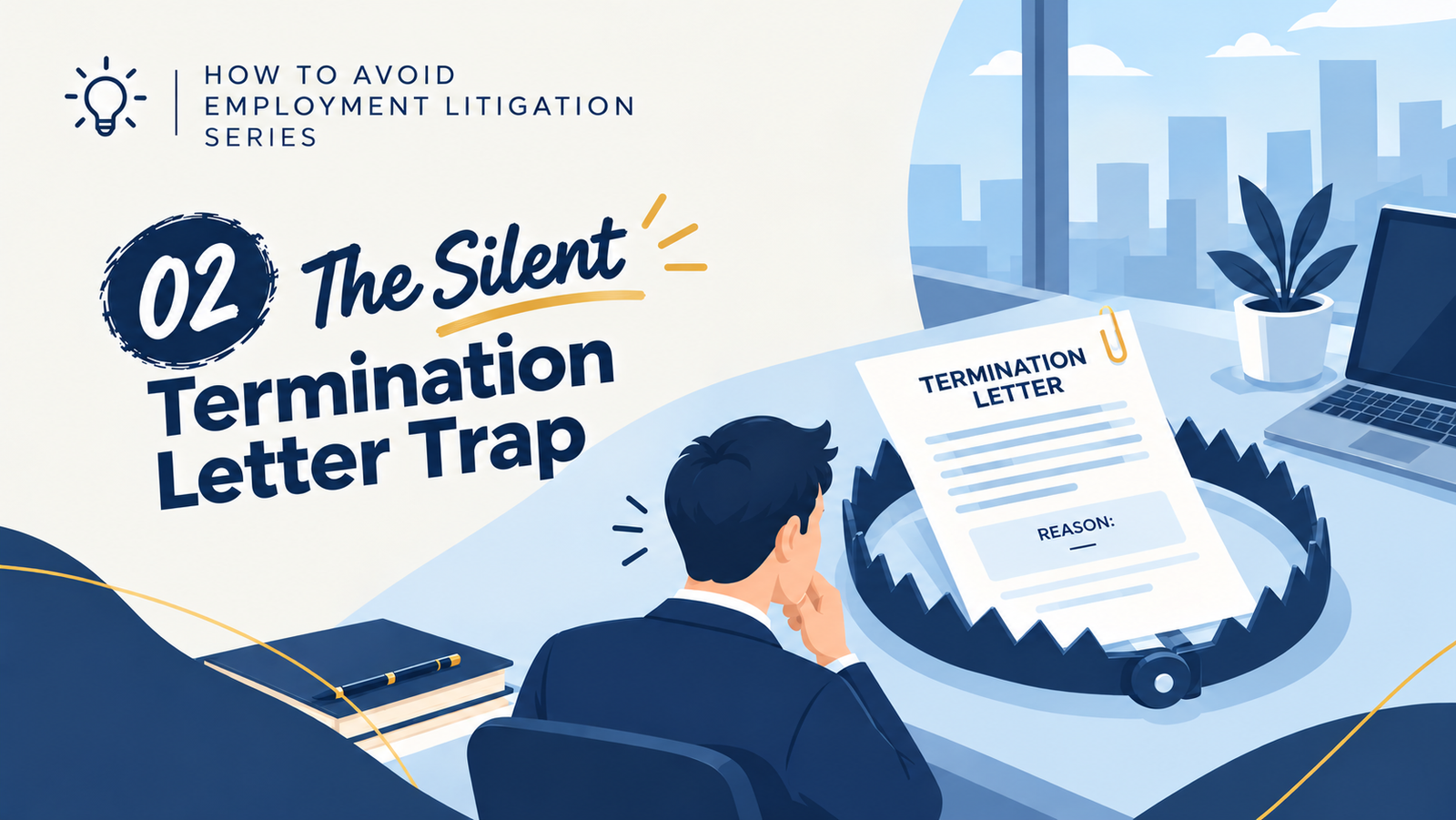
Do you know that your simple termination letter without assigning any reason may bar you or pose great difficulty to you from subsequently raising one to justify the termination in Malaysia?
The “Just Cause or Excuse” framework in Malaysia is well established as a fundamental statutory right to which every employee is entitled not to be fired without a legally valid reason. As such, it becomes incumbent for every employer to provide their termination reason in their termination letter, failing which, the chance of facing a subsequent unfair dismissal claim at the Industrial Court is almost certain.
From our litigation experience, we frequently see business owners and corporate clients who actually possessed a valid and strong reason to terminate a worker – fully backed by sufficient evidence – yet they chose to leave the termination letter completely blank without any reason or relied on a simple “termination simpliciter” notice clause.
This creates an unnecessary, high-stakes hurdle in defending the suit because –
👉 Having a good reason to fire someone does not prove that you actually fired them for that reason.
So how does the Court know what reason relied on by the employer to terminate?
👉 Starts with the termination letter.
🏛️ The Legal Reality: What the Federal Court in Malaysia Says
In the locus classicus of Goon Kwee Phoy v. J & P Coats (M) Bhd [1981] 2 MLJ 129, the Federal Court in Malaysia has established the principle that the duty of the Industrial Court is to enquire into the reason advanced by the employer and not other reason:
“…Where representations are made and are referred to the Industrial Court for enquiry, it is the duty of the court to determine whether the termination or the dismissal is with or without just cause or excuse. If the employer chooses to give a reason for the action taken by him, the duty of the Industrial Court will be to enquire whether that excuse or reason has or has not been made out. If it finds as a fact that it has not been proved, then the inevitable conclusion must be that the termination or dismissal was without just cause or excuse. The proper enquiry of the court is the reason advanced by it and that court or the High Court cannot go into another reason not relied on by the employer or find one for it.”
This principle was later revisited by the Federal Court in Maritime Intelligence Sdn Bhd v. Tan Ah Gek [2021] 10 CLJ 663 wherein the Federal Court has clarified it and did not limit it to the bounds in the termination letter so long as “it is the reason operating in the minds of the employer at the time of the dismissal”:
“[49] In a situation where the employer gave no reasons whatsoever for dismissing the workman, the scope of the Industrial Court’s adjudication is still tied to the representations and thereby to the factors operating in the mind of the employer at the time of the dismissal. The fact that those reasons have not been articulated does not alter the object and effect of s. 20(1) or 20(3). The Industrial Court is bound to restrict the inquiry to that extent. This issue is considered in further detail below.
[50] There is no provision for the Industrial Court to consider matters outside of the representation by the workman, under s. 20(3). Matters outside of the representation would include matters which were not operative in the employer’s mind when the decision to dismiss was taken, but which the employer chooses to put forward post-dismissal at a subsequent stage in the Industrial Court, to justify the decision to dismiss the workman, ex post facto. The very specific wording of s. 20 does not prescribe or allow an overarching survey by the Industrial Court of any and all matters both pre and post- dismissal, in an effort to ascertain whether the workman’s representations are made out.
[51] In summary, on this point, it is the statutorily prescribed function of the Industrial Court to examine, investigate the representations of the workman and then hand down an award under s. 20(3). It is not the function of the Industrial Court to decide otherwise than prescribed by the Act. The Act implicitly prescribes an investigation into facts and events and reasons at the point and/or time of dismissal. There is no provision in the Act for the industrial tribunal to embark on a far-ranging survey to ascertain whether given matters which the employer has discovered subsequently and not put to the workman, it is justified in dismissing the workman.”
⚠️ The Corporate Fallout of Saying Nothing
Even though the “operating minds” test technically allows unarticulated reasons to be argued, leaving them out of your termination letter exposes your company to two severe strategic vulnerabilities:
• ⏳ The “Afterthought” Penalty: Reason raised and maintained in the termination letter is contemporaneous whereas reason raised subsequently may be viewed as afterthought or may carry less probative value.
• 🛑 The Double Burden of Proof: Instead of jumping straight into court to prove your reason was justified, costly legal battle is first fought just to prove what your reason actually was at the time of the sacking.
In high-stakes litigation, this self-inflicted procedural friction is precisely what turns the tide of a legal battle against a company.
Therefore, a prudent employer should still explicitly state the reason for dismissal in the termination letter to ensure that a strong defence is not whittled down due to avoidable omission.
🛡️ De-Risk Your Medini & JS-SEZ Footprint
By knowing what could go wrong and some common pitfalls in local employment in Malaysia, you can then navigate and venture your business here with confidence and grow your human capital with the vibrant, multilingual local workforce available while “Plug and Play” in JS-SEZ.
🚀 Missed our framework breakdown last week?
Catch up on Episode 01: Knowing the Key Differences, where we contrasted Singapore’s contract flexibility with Malaysia’s statutory rigidity.
👉Read here: https://sklowco.com/how-to-avoid-employment-litigation-01-js-sez-employment-law-singapore-vs-malaysia-guide.
🎁 Download Your Complimentary Executive Guide
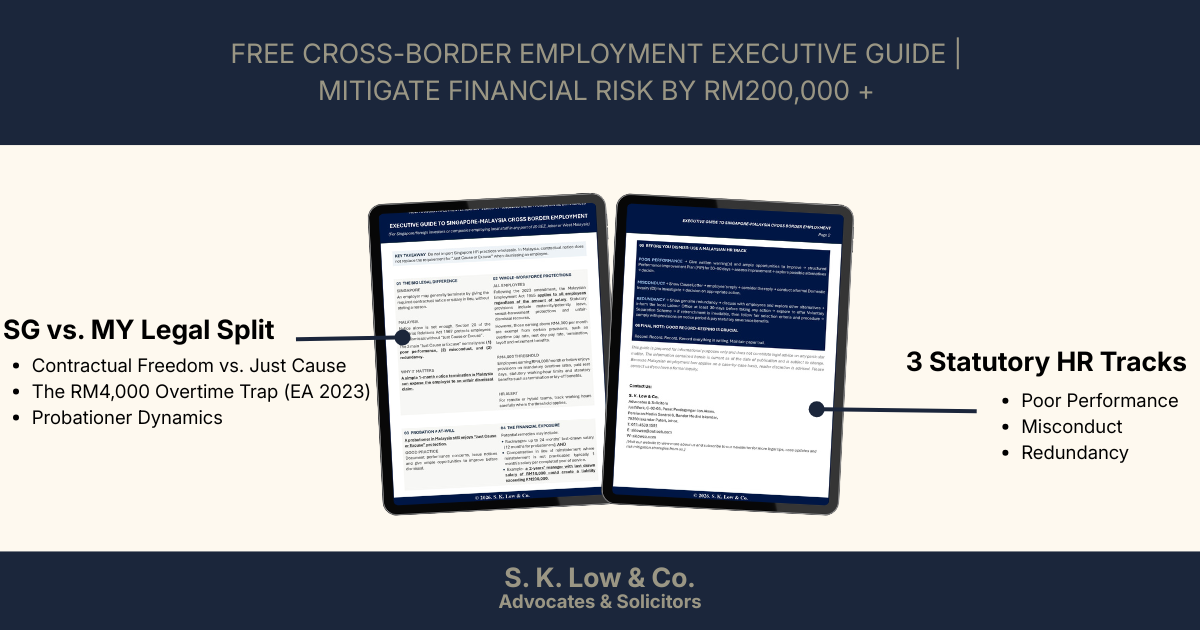
To help cross-border boards systematically audit their employment infrastructure, we have mapped these exact documentation rules, salary thresholds, and statutory tracks into a single, high-resolution 2-page executive tool:
📘 Executive Guide to Singapore-Malaysia Cross Border Employment
- The Big Legal Differences (Notice vs. Just Cause)
- The RM4,000 Overtime Trap (EA 2023 Rules)
- Step-by-Step Statutory HR Workflows (Performance, Misconduct, Redundancy)
Please complete the brief corporate form below to receive your high-resolution PDF download link instantly via email. Protect your Johor footprint by verifying your employment compliance today.
This post is prepared for informational purposes only and does not constitute legal advice on any particular matter. The information contained herein is current as of the date of publication and is subject to change. Because Malaysian employment law applies on a case-by-case basis, reader discretion is advised. Please contact us if you have a formal inquiry.