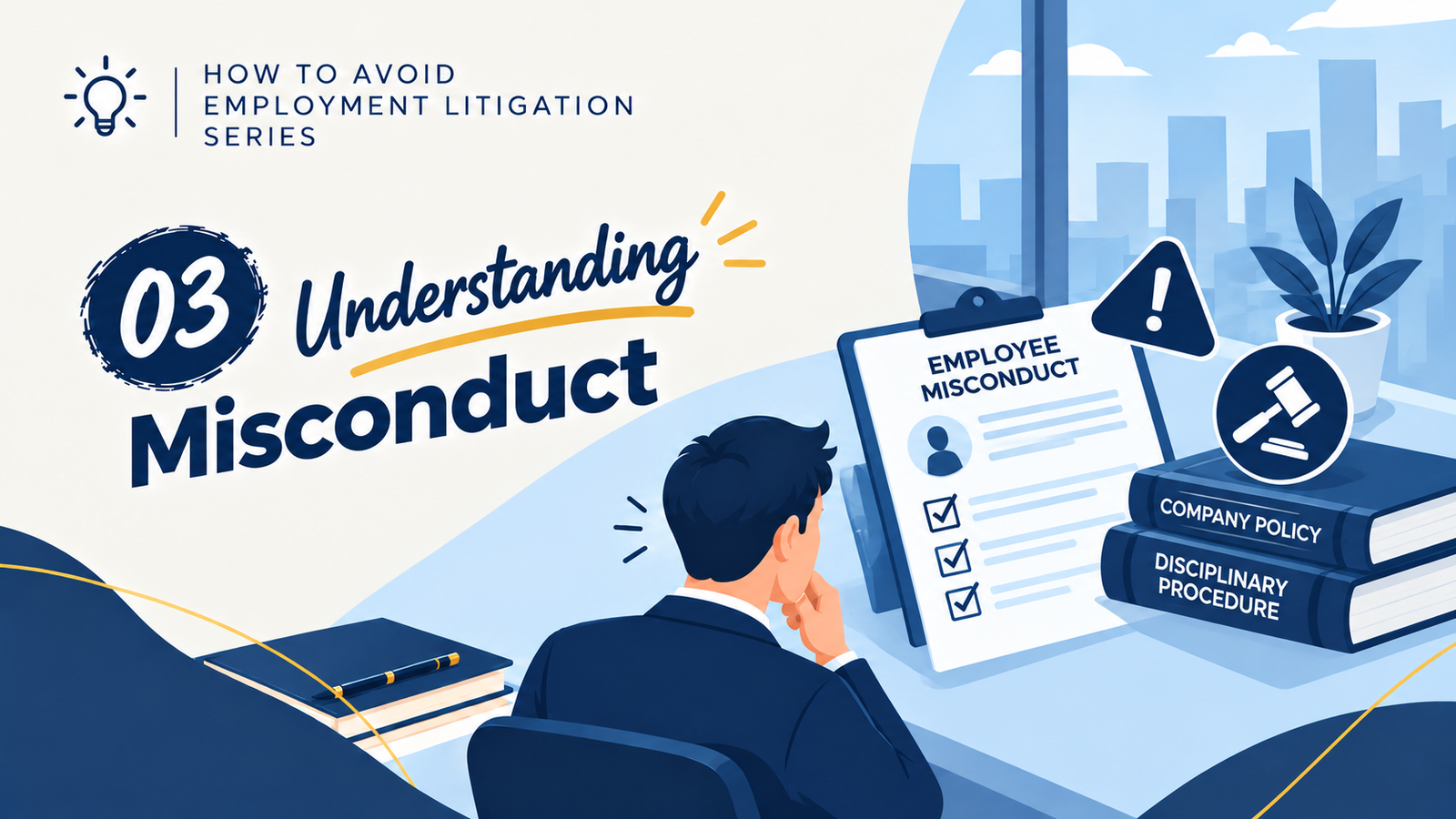
When a workplace misconduct escalates to the Malaysian Industrial Court, everything hinges on how the employer handled it.
If you are a local or cross-border HR professional or business leader having operation or exploring business opportunities in the Johor-Singapore Special Economic Zone (JS-SEZ) or other parts of Johor, here is your essential, scannable cheat sheet to understanding the ground rules. 👇
⚖️ The Legal Threshold
• Burden of proof: Employer handles 100% of the burden.
• Standard of Proof: Balance of probabilities (Is it more likely than not? >50% certainty).
• The Industrial Court’s 2-Fold Test:
1. Did the misconduct actually happen?
2. Was the misconduct serious enough to justify dismissal?
🔴 What Actually Counts as Misconduct?
Misconduct isn’t just poor performance. It includes:
• Integrity Issues: Theft, fraud, dishonesty.
• Behavioral Issues: Insubordination, violence, sexual harassment.
• Contractual Breaches: Breach of express or implied duties including conflict of interest, breaking confidentiality, chronic absenteeism.
🔍 The Domestic Inquiry (DI) Myth
Is a formal DI mandatory? No.
• The Law: Landmark case like the Federal Court‘s decision in K C Mathews v. Kumpulan Guthrie Sdn Bhd [1981] CLJ (Rep) 62 held that a formal DI is not an absolute statutory requirement if the evidence is undeniable or the employee admits to it. The Supreme Court in Dreamland Corp. (M) Sdn. Bhd. v. Chong Chin Sooi & Industrial Court of Malaysia [1988] 1 CLJ (Rep) 39 affirmed the principle and decided that the employer still needs prove his dismissal is justified in the Industrial Court.
• The Reality: The Industrial Court will hear the matter afresh. The employer must still prove the dismissal was justified.
• The Rule of Thumb: Employer should always conduct some degree of “due inquiry” to give the employee a fair opportunity to defend himself before deciding his guilt.
💡 Takeaway: Document everything, conduct some due inquiry, ask for an explanation or reply before arriving at any finding of guilt or taking any disciplinary action.
Be that as it may, are there any circumstances where a formal domestic inquiry should still be carried out? What is the procedure? Can you fire outright if misconduct is established?
Let’s explore more in the upcoming episode!
This post is prepared for informational purposes only and does not constitute legal advice on any particular matter. The information contained herein is current as of the date of publication and is subject to change. Because Malaysian employment law applies on a case-by-case basis, reader discretion is advised. Please contact us if you have a formal inquiry.