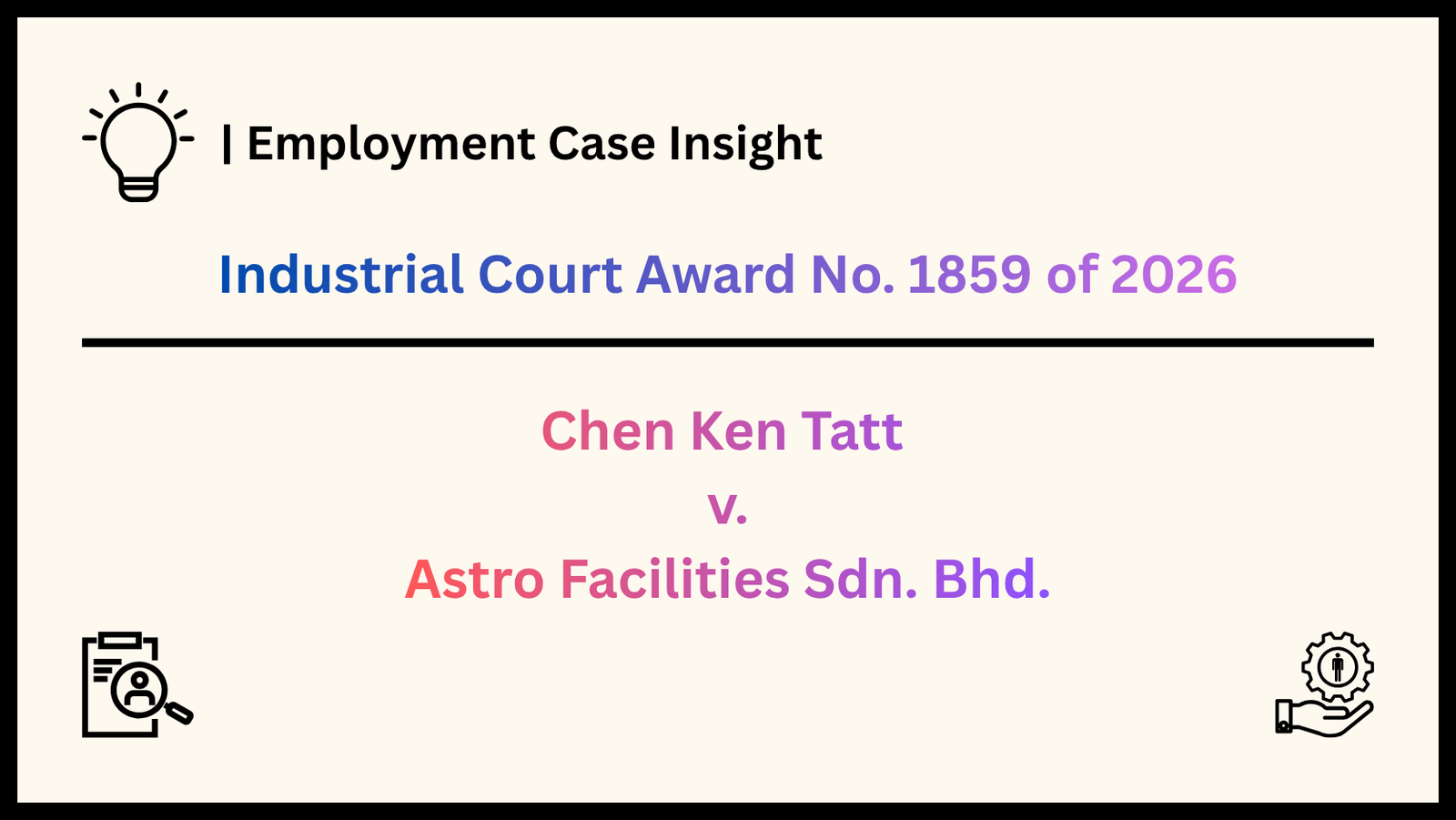
Industrial Court Award No. 1859 of 2026 – Chen Ken Tatt v. Astro Facilities Sdn. Bhd.
[An expensive RM474k lesson for employers on Domestic Inquiry (DI) and the burden of proof]
In a recent Industrial Court Award No. 1859 of 2026, a prominent local media and entertainment brand paid a costly price for dismissing a cameraman over alleged digital misconduct.
The company accused the employee of abusing his corporate account to upload copyrighted digital contents onto an illegal, third-party pirate streaming application.
The company followed standard procedures: Initial meeting > Asked written explanation > Convened DI > Dismissal with finding of guilt.
Yet, the Industrial Court disagreed with the DI’s decision and ordered the company to pay RM474,240.00 in compensation. 💰
🔍 Where Did the Employer Go Wrong?
The Industrial Court clarified and found that:
👉Involvement ≠ Guilt, Intent or Negligence Must Be Proven: It is not enough for an employer to simply show that an employee’s account credentials (email or phone number) were linked to the illegal streaming. The company failed to prove that the Claimant intentionally streamed the content, or was negligent enough to let it happen—especially since he had previously shared his credentials with another staff member for technical assistance.
👉No Shifting of Burden: An employer cannot force an employee to “prove a negative” (i.e., prove they didn’t do it). The burden of proof rests squarely on the employer.
👉Flawed Investigation: The company failed to link the illegal streaming to any physical devices belonging to the Claimant or his family. He was subsequently acquitted of the criminal copyright offence by the Sessions Court, and later upheld by the High Court.
💡 Key Takeaways for HR & Employers:
📌 DI Decisions Are Not Bulletproof
- Never assume a DI panel’s decision is safe from judicial scrutiny. The Industrial Court hears cases afresh and is not bound by internal DI decisions.
📌Prove Every Charge’s Elements with Sufficient Evidence
- While the standard of proof in employment misconduct is “balance of probabilities” (>50%), employers must still substantiate every element of the misconduct charge with sufficient, credible evidence.
📌 Investigate Beyond the Digital Footprint
- In the age of cyber-vulnerabilities, credential sharing, and hacking, do not rely solely on system logs. Conduct deep, thorough investigations to tie the digital action to the physical individual.
📌 Weigh Parallel Criminal Outcome
- If the alleged misconduct is also a criminal offence, closely monitor the police investigation. A total lack of evidence in criminal court may heavily weaken your justification for dismissal.
Note: This decision may be subject to appeal. Informational only and not legal advice. Reader’s discretion is advised.